

Rapid Tooling Solutions — First Parts in as Fast as 7 Days
Skip the long lead times. Dimud delivers precision-molded sample parts fast, so you can validate, iterate, and move to market without delays.
- ISO Certified
- Quote Within 24 Hours
- In-House Mold Factory
An NDA can be signed if needed before the quotation.
What Is Rapid Tooling?
Rapid Tooling is a mold manufacturing method designed to significantly shorten mold development cycles. Compared to traditional mass-production molds, which often have lead times of 6–12 weeks, Rapid Tooling typically completes mold manufacturing and delivers the first batch of injection-molded samples within 1–3 weeks.
This does not mean compromising on quality; rather, by optimizing mold structure design and selecting appropriate mold materials (such as aluminum alloy or pre-hardened steel), it significantly reduces development time and upfront costs while still meeting product validation requirements.
For teams that need to conduct functional validation, visual confirmation, or small-batch market testing before full-scale production, Rapid Tooling is the most efficient path forward.
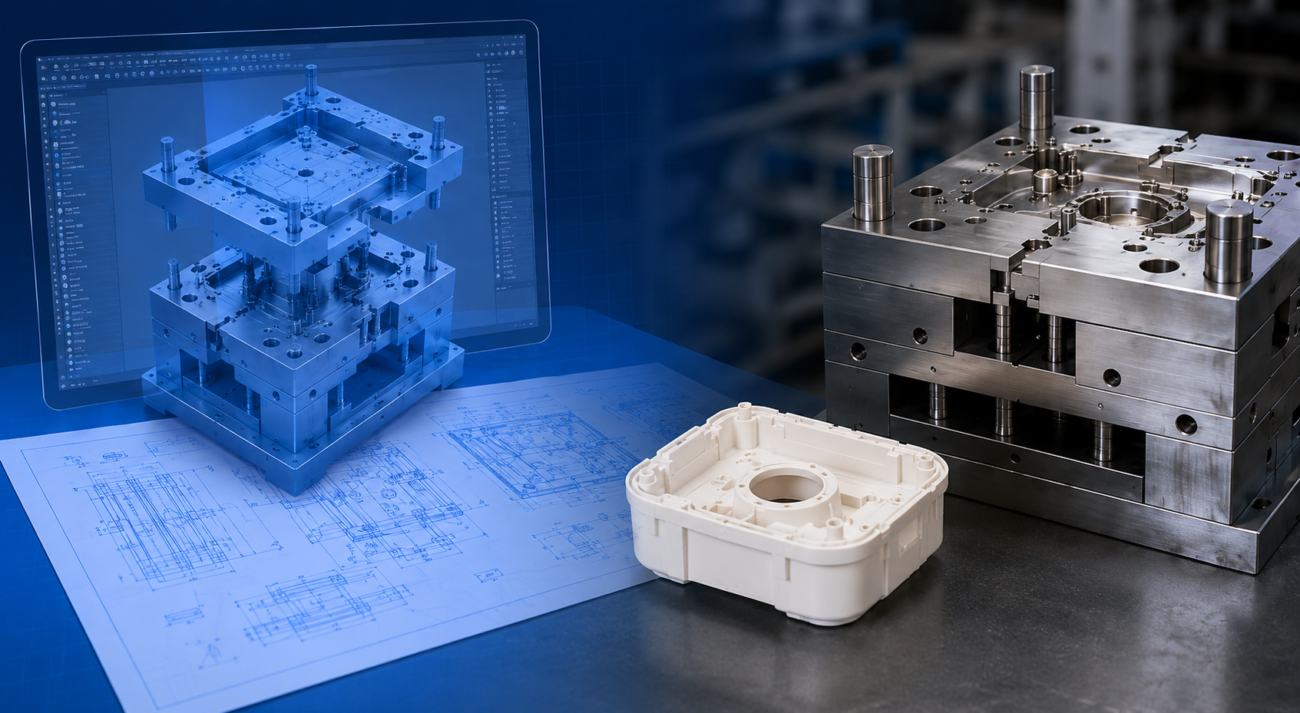
Prototype Tooling
Suitable Stage: Product R&D and Validation Phase
Mold Material: Primarily aluminum alloy molds
Typical Lead Time: 7–10 business days
Suitable Quantity: 50–500 pieces
Core Value: Obtain authentic injection-molded prototypes at the lowest cost and in the shortest time for structural validation, assembly testing, and appearance review
Applicable Scenarios: MVP validation for startup teams; confirmation of structural adjustments during product iteration
Bridge Tooling
Suitable Stage: Product transition phase during mass-production mold development
Mold Material: P20 pre-hardened steel or H13 tool steel
Typical Lead Time: 2–4 weeks
Suitable Quantity: 500–10,000 pieces
Core Value: Produces a batch of parts highly consistent with the final product before the official mass-production mold is completed, meeting market launch deadlines or customer sample requirements
Applicable Scenarios: Early market launch of new products, supply chain transition periods, and small-batch market rollouts
Rapid Tooling vs. Traditional Production Molds
| Comparison Criteria | Rapid Tooling | Traditional Production Molds |
|---|---|---|
|
Mold Delivery Time |
1–3 weeks |
6–12 weeks |
|
Mold costs |
Low ($800–$5,000) |
Higher ($5,000–$50,000+) |
|
Mold life |
Several thousand to several ten thousand cycles |
From hundreds of thousands to over a million cycles |
|
Applicable output |
Small batches (50–10,000 units) |
Mass production |
|
Design flexibility |
High, easy to modify or restart |
Low, high mold repair costs |
|
Range of Materials |
All common engineering plastics are supported |
Full range of materials |
Our Rapid Tooling Capabilities
From aluminum prototype molds to bridge tooling in hardened steel — engineered for speed, built for precision.
Mold Types and Specifications
| Specification Dimensions | Parameter Description |
|---|---|
|
Mold Type |
Aluminum Alloy Tooling / P20 Steel Tooling / H13 Hardened Steel Tooling |
|
Mold cavity layout |
From single-hole (1+1) to multi-hole (1+4) configurations, flexibly tailored to production requirements |
|
Maximum mold dimensions |
Maximum machining dimensions per mold: 600 mm × 500 mm × 400 mm |
|
Dimensional Tolerances and Accuracy |
Standard tolerance: ±0.05 mm; critical mating surfaces can achieve ±0.02 mm |
|
Minimum wall thickness |
0.8 mm (depending on the material and structure) |
|
Surface treatment |
Polishing (SPI standard) / Textured etching (MT standard) / Sandblasting / Plating resist |
|
Mold life |
Aluminum molds: 5,000–50,000 cycles; Steel molds: 50,000–500,000 cycles |
|
Lead time for a single mold |
As fast as 7 business days (aluminum molds); steel molds and bridge tooling typically take 2–4 weeks |
Supported Materials Library
We support rapid injection molding production for a wide range of engineering plastics, covering everything from general-purpose materials to high-performance materials:
| Material Category | Specific materials | Typical Use Cases |
|---|---|---|
|
General-purpose engineering plastics |
ABS、PP、PE、PS |
Housings, covers, structural components |
|
High-Performance Engineering Plastics |
PC、PA6、PA66、POM |
Precision structural components, gears, connectors |
|
Fiberglass-reinforced materials |
PA66+GF30、PP+GF20 |
High-strength structural components, automotive parts |
|
Flexible materials |
TPE、TPU |
Seals, grips, flexible housings |
|
Flame-retardant materials |
PC/ABS FR、PA6 FR |
Electronic enclosures, medical device components |
|
High-temperature materials |
PPS、PEEK |
Industrial-grade components for high-temperature applications |
Manufacturing Capabilities
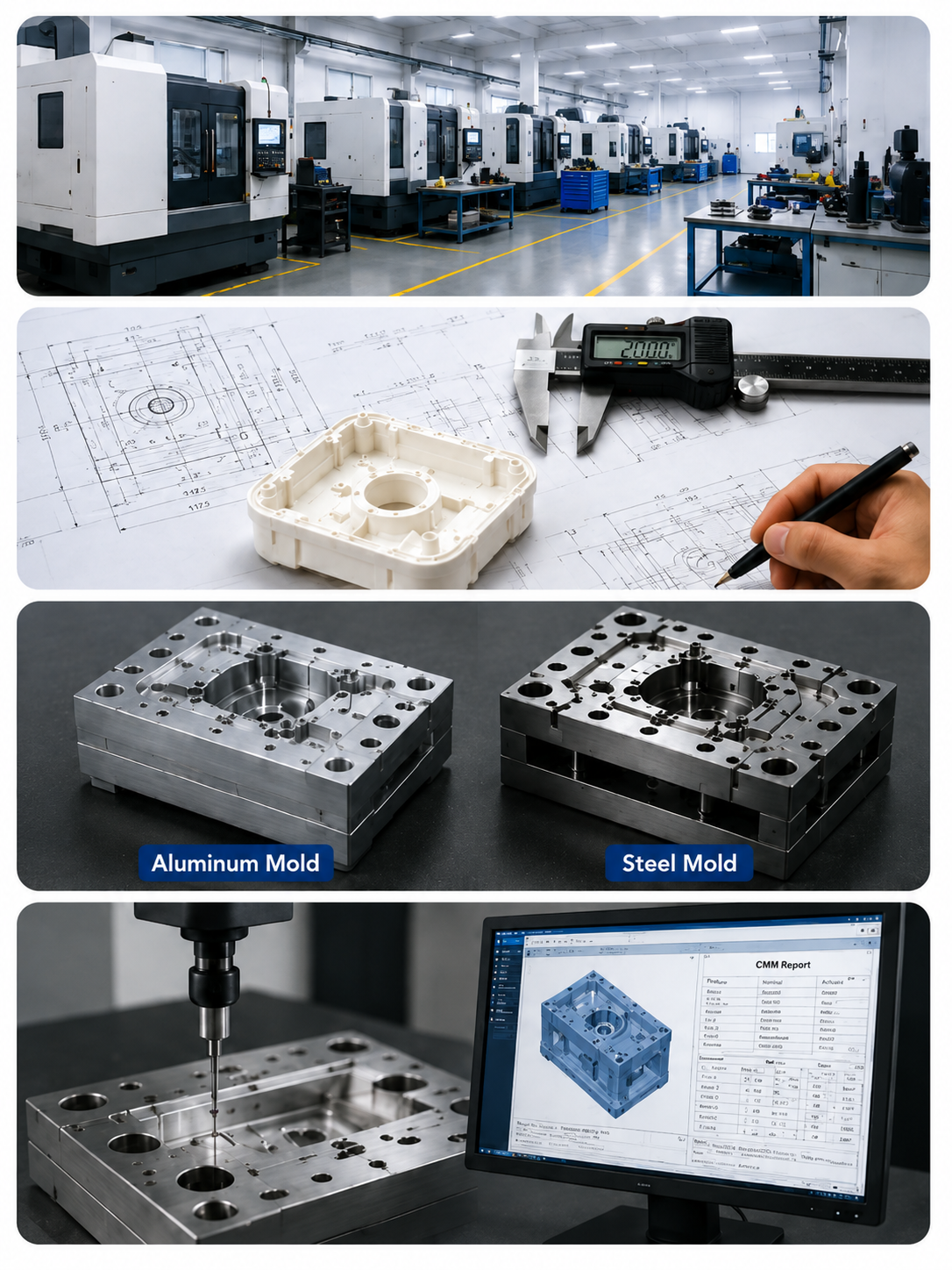
Dimud operates three in-house manufacturing facilities and has full in-house mold-making capabilities, eliminating the need to outsource any core manufacturing processes:
High-Speed CNC Machining
High-speed 5-axis milling, suitable for high-precision machining of aluminum and steel mold cavities, with a surface roughness as low as Ra 0.4 μm
EDM (Electrical Discharge Machining)
Precision EDM processing of complex, irregular cavities, deep ribs, and fine text, ensuring a level of precision and detail reproduction that conventional machining cannot achieve.
Wire Electrical Discharge Machining (WEDM)
Used for high-precision contour machining of inserts, sliders, and precision-fit components, ensuring the fitting accuracy of all functional parts in the mold
CMM (Coordinate Measuring Machine) Inspection
Once the mold is completed, a CMM is used to perform a full inspection of critical dimensions, and a formal dimensional report is issued to ensure the traceability of the mold delivery data.
How It Works — From File to First Parts
A streamlined 6-step process designed to eliminate uncertainty and keep your project on schedule.
Step 01 — Upload Your Design
Submit your CAD files (STEP, IGES, STP, or STL formats are supported) and provide basic requirements, including the target material, estimated quantity, and delivery schedule.
Step 02 — DFM Review & Quotation
The engineering team conducts a Design for Manufacturability (DFM) analysis of the design documents to identify potential wall thickness issues, insufficient draft angles, or structural risks, and provides a quotation at the same time.
Step 03 — Mold Design & Confirmation
Based on the approved design, proceed with the mold structure design, including parting line planning, gate placement, and cooling system layout. Once completed, submit the design to the client for review and approval.
Step 04 — Tooling Fabrication
Once the mold enters the machining phase, the core and frame are manufactured using CNC precision milling, EDM (electrical discharge machining), and high-precision grinding processes. A dedicated engineer monitors progress throughout the entire process.
Step 05 — T1 Sampling & Approval
The initial mold trial has been completed, and the T1 prototype has been delivered, accompanied by the First Article Inspection (FAI) report and critical dimensional measurement data. Production will commence only after the customer’s approval.
Step 06 — Production & Delivery
We proceed with formal injection molding production in accordance with the confirmed process parameters. After passing visual and dimensional inspections, the products are packaged, shipped via international logistics, and tracked throughout the entire process.
See how our rapid prototyping tools are used in the industry
Rapid Tooling built for the precision demands of your industry — from regulated medical components to high-volume automotive parts.
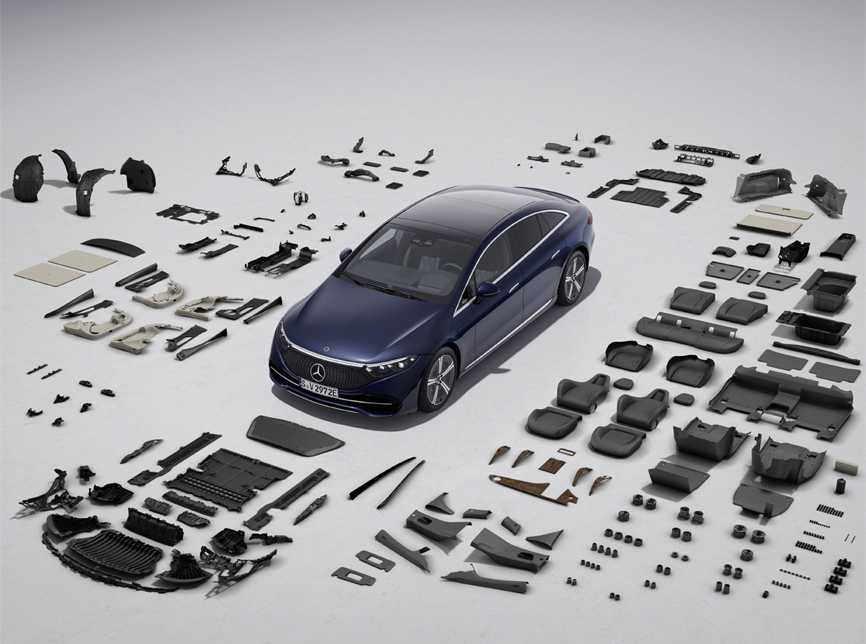
As development cycles for new automotive models continue to shrink and component validation milestones are brought forward, traditional mold development cycles are significantly slowing down overall vehicle R&D progress.
Dimud’s Solution:
We use Rapid Tooling to quickly deliver injection-molded parts for validation, supporting assembly testing, crash simulations, and supplier certification processes, and confirming key milestones before the mass-production mold project is approved.
Key Applications:
- Dashboard and interior trim structural components
- Sensor mounts and ADAS module housings
- Wire harness clips and connector sleeves
- Engine compartment thermal insulation and sealing components
Dimensional tolerances within ±0.05 mm / Supports high-performance materials such as PA66+GF and PPS / Complete dimensional reports available
Before medical devices can be brought to market, they must undergo multiple rounds of functional validation and regulatory review. Prototypes must closely match the materials and structure of the final mass-produced parts; standard 3D-printed parts cannot meet these testing requirements.
Dimud’s Solution:
We provide authentic injection-molded prototypes made from the same materials as mass-produced parts, supporting biocompatibility testing, assembly and functional validation, and regulatory submissions to shorten the product registration cycle.
Key Applications:
- In vitro diagnostic (IVD) device housings and functional components
- Surgical instrument grips and operational structural components
- Modular injection-molded parts for single-use consumables
- Aesthetic and structural components for wearable medical devices
Supports medical-grade PC, ABS, PP, and TPE materials / Cleanroom production / Material compliance documentation is available


Consumer electronics products undergo rapid iterations, and the time required to develop new molds directly impacts the time-to-market window. Industrial electronics products demand high precision in housing dimensional fit, making it difficult to control the costs associated with trial molding and mold modifications.
Dimud’s Solution:
We use aluminum alloy rapid prototyping to shorten the lead time for the first mold. Combined with DFM analysis, we identify fit precision risks before mold development begins, reducing the number of mold modifications and helping customers meet their product launch deadlines.
Main Application Scenarios:
- Consumer electronics enclosures and back covers
- Industrial control module enclosures and mounting brackets
- Connector insulators and terminal sleeves
- Heat dissipation components and airflow deflectors
SPI A2 polish on visible surfaces / Support for flame-retardant PC/ABS FR materials / Minimum wall thickness of 0.8 mm / Support for EMI shielding structures
The robotics and energy storage industries are experiencing rapid growth, with frequent product iterations. R&D teams need to physically validate multiple design concepts within extremely short timeframes, and traditional mold-making methods cannot keep pace with this rapid iteration cycle.
Dimud’s Solution:
Utilizing Rapid Tooling to support high-frequency iteration needs, with short lead times and low costs for single mold modifications or remakes. Combined with small-batch injection molding capabilities, this enables R&D teams to thoroughly validate every design iteration before mass production.
Key Application Scenarios:
Robotic arm joint housings and connecting structural components
Battery module end plates and insulation/isolation components
Energy storage cabinet cable management and mounting brackets
Robotic sensor mounting brackets and protective housings
Key Requirements: Support for high-strength PA66+GF / POM / PC materials / Support for complex side-core-pulling structures / Seamless transition from the prototyping stage to mass production

Tell us about your industry and your part requirements, and the Dimud engineering team will provide you with a customized rapid tooling feasibility assessment and quote within 24 hours.
Why Choose Dimud for Rapid Tooling?
Not just fast — engineered right the first time.
We are not middlemen; we are manufacturers
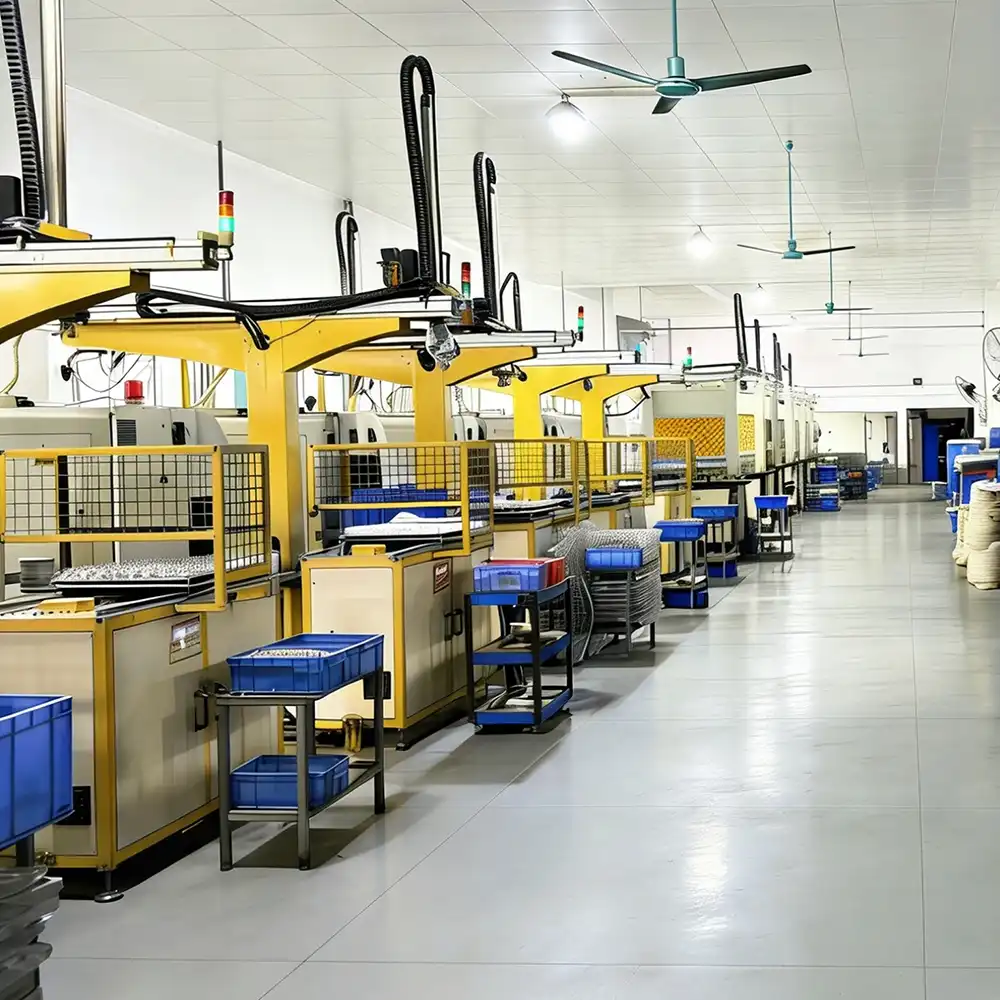
With our in-house mold shop at the core of our operations, Dimud handles all Rapid Tooling projects—from mold design to injection molding—entirely in-house. There is no outsourcing, no communication gaps, and we take direct responsibility for both delivery times and quality.
First-Shot Accuracy, Fewer Iterations
Before launching any Rapid Tooling project, we conduct a mandatory DFM (Design for Manufacturability) review to identify issues such as uneven wall thickness, insufficient draft angles, and the risk of shrinkage early on. This helps minimize the likelihood of rework during trial molding from the outset, saving you time and money.
Steel or Aluminum — You Decide, We Deliver
We have the capability to develop both aluminum alloy rapid-prototyping molds and P20/H13 steel molds. We use aluminum molds for prototype validation to control costs and lead times, and switch to steel molds for small-batch production to ensure both mold longevity and part consistency. We are a one-stop supplier covering all your mold needs from validation through to pre-mass production.
Fast turnaround without compromising accuracy
Dimud’s Rapid Tooling projects maintain standard tolerances within ±0.05 mm, with critical mating surfaces achieving tolerances as tight as ±0.02 mm. Upon completion of each mold, a CMM (Coordinate Measuring Machine) report is issued, ensuring data traceability and verifiable precision.
What You Need to Know About Custom Parts Manufacturing
Choose 3D printing if you need to validate a design concept; choose Rapid Tooling if you need to test the performance of actual materials, check assembly fit, or submit samples for customer certification and regulatory review—the test results for injection-molded parts are closer to those of the final production parts.
Aluminum molds are suitable for small-batch production of up to 50,000 cycles but are not suitable for long-term, high-volume mass production. When transitioning to mass production, Dimud can directly upgrade the mold to a steel mass-production mold on the same platform without the need to resubmit design files.
To initiate a quote and DFM review, please provide 3D CAD files in STEP or IGES format, along with 2D engineering drawings (PDF) that specify critical tolerances and material specifications.
Aluminum alloy rapid tooling starts at approximately $800, while P20 steel Bridge Tooling typically ranges from $2,000 to $8,000. You will receive an accurate quote within 24 hours of submitting your drawings.
A formal NDA can be signed prior to project commencement. Design documents are subject to tiered access controls, and only engineers directly involved in the project are authorized to view them. We have a long history of serving clients in Europe and the United States and have established robust intellectual property protection procedures.
We offer mirror polishing (SPI standard), textured etching (MT standard), sandblasting, and natural finish. If you require painting, electroplating, or screen printing, we can coordinate secondary processing to complete these steps as well.
Each set of molds comes with a CMM (Coordinate Measuring Machine) report. If the dimensions of the sample parts exceed the agreed-upon tolerances, we will be responsible for modifying the molds at no additional cost.
Yes. The same rapid-prototyping mold supports testing of multiple compatible materials, allowing you to compare the shrinkage, warpage, and appearance of different materials before mass production. Please notify us in advance when switching materials.
Yes, Dimud supports complex structures such as side-ejector sliders, inclined-piston recesses, and insert assemblies. Complex structures typically add 3–5 business days to the process, and feasibility is assessed in advance during the DFM phase.