
The global market for rugged handheld terminals — devices used in warehouse scanning, field service, and retail point-of-sale environments — is intensely competitive on two dimensions simultaneously: product reliability and manufacturing cost efficiency. Enclosure assemblies for these devices are deceptively complex. What appears to be a straightforward plastic housing conceals a demanding set of requirements: multi-wall snap-fit assemblies that must align within fractions of a millimeter, surface textures that must survive 100,000+ daily grip cycles without visible wear, EMI-shielding rib geometry inside the cavity, and ventilation louvers that must not compromise structural integrity.
When a German industrial technology company came to Димуд in early 2025, they were not looking for a prototype house — they needed a manufacturing partner capable of taking over a full production program on an accelerated timeline. Their previous supplier had delivered inconsistent dimensional conformance on the snap-fit interfaces between the main housing body and the pistol-grip base unit, leading to a 6.2% field failure rate attributed to housing separation under drop conditions. The client needed a new solution — and they needed it fast.
This case study documents how Dimud’s integrated mold engineering, precision injection molding, and cross-factory production model transformed a troubled housing program into a stable, high-yield production line delivering 99.4% first-pass acceptance.
Client Background and Challenge
Who They Are
The client is a German-headquartered company with a logistics automation division that designs and sells rugged mobile data terminals to European warehouse operators, third-party logistics providers, and retail chain distribution centers. Their MDT product line competes in the mid-market segment — devices that are ruggedized for industrial use but sold at a price point that makes supply chain cost discipline critical. Their products are distributed across Germany, the Netherlands, and Poland, with growing demand in the UK market.
Why They Were Looking for a New Supplier
The client had been working with a plastic injection molding factory in eastern China for approximately three years. The relationship began well — early samples were acceptable — but as annual volumes scaled from 15,000 to 50,000 units, quality consistency deteriorated. Specifically:
- Snap-fit dimensional drift: The four interlocking snap-fit hooks connecting the main body to the grip assembly exhibited dimensional variation of up to ±0.18 mm across production batches, against a design specification of ±0.05 mm. This caused audible clicking and housing flex in the field.
- Surface texture inconsistency: The fine cross-hatch texture (MT-11020 equivalent) applied to the grip body showed orange-peel defects on approximately 8–12% of units due to inconsistent mold temperature management.
- Communication failures: Engineering change requests took 10–14 business days to receive a written DFM response. The client’s product team could not iterate rapidly enough to meet their own launch schedules.
The client’s procurement director reached out to Dimud following a referral from a Danish electronics contract manufacturer who had successfully used Dimud for a medical device enclosure project. After reviewing Dimud’s case study portfolio, they submitted an RFQ with 3D CAD files and a detailed technical specification sheet.
Product Description and Technical Specifications
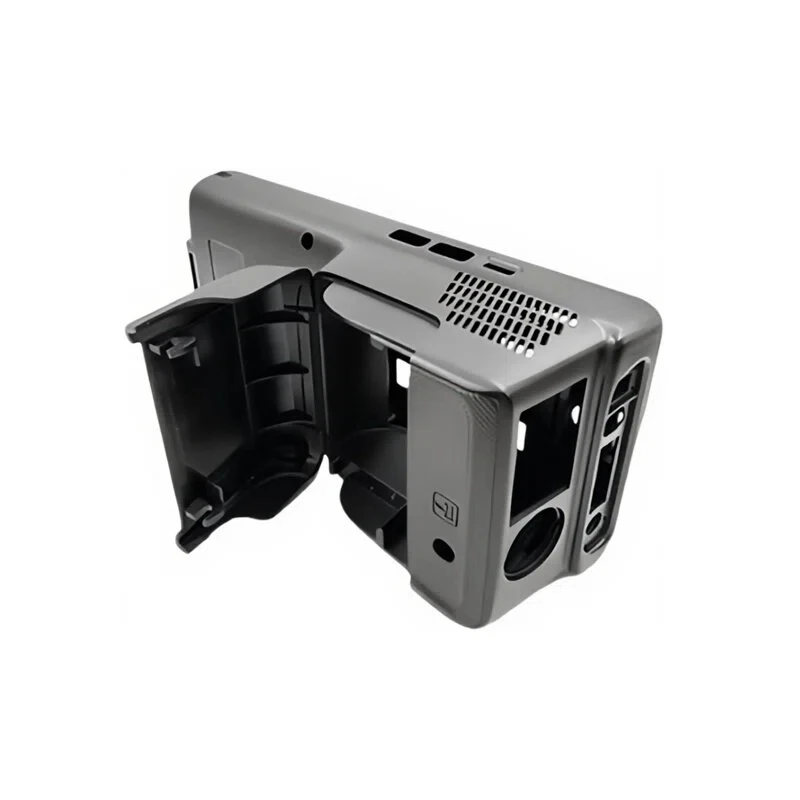
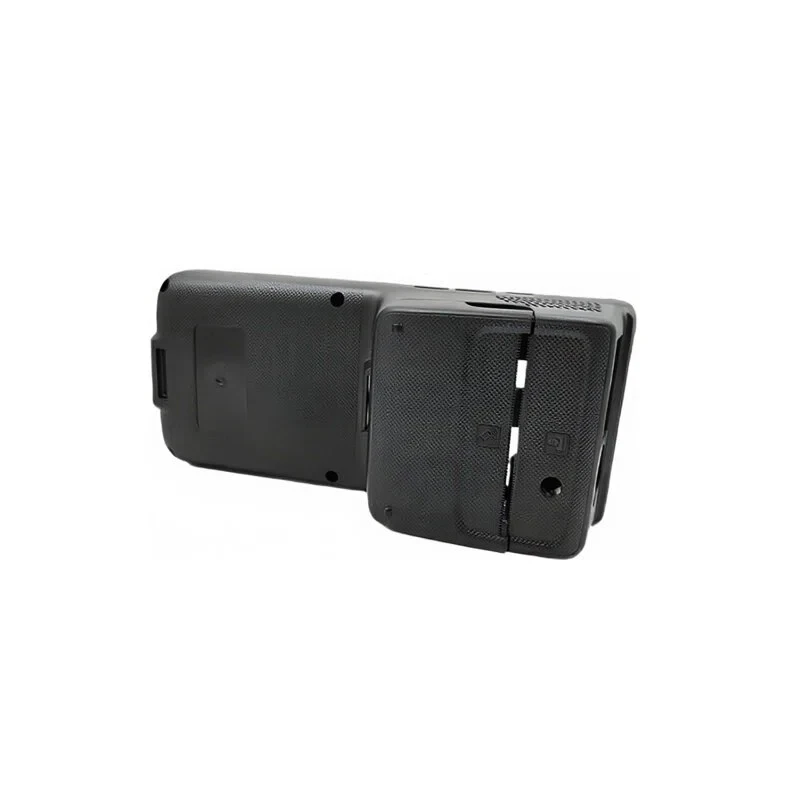
The enclosure assembly consists of six injection-molded components that together form the complete outer shell of the handheld terminal:
| Component | Материал | Цвет | Отделка поверхности | Толщина стенок | Critical Tolerance |
|---|---|---|---|---|---|
| Main body front shell | PC+ABS (Sabic C6200-HF) | Warm Gray (RAL 7044) | SPI B-2 semi-gloss | 2.0 – 2.5 mm | ±0.05 mm on snap hooks |
| Main body rear shell | PC+ABS (Sabic C6200-HF) | Warm Gray (RAL 7044) | SPI B-2 semi-gloss | 2.0 – 2.5 mm | ±0.05 mm on PCB boss height |
| Pistol-grip front half | ABS (LG-Chem HI-121H) | Matte Black | MT-11020 fine texture | 2.0 – 3.0 mm | ±0.08 mm on hinge pin bore |
| Pistol-grip rear half | ABS (LG-Chem HI-121H) | Matte Black | MT-11020 fine texture | 2.0 – 3.0 mm | ±0.08 mm on hinge pin bore |
| Battery door | ABS (LG-Chem HI-121H) | Matte Black | MT-11020 fine texture | 1.8 mm | ±0.06 mm on latch travel |
| Cradle docking insert | PC+ABS (Sabic C6200-HF) | Matte Black | SPI A-3 low gloss | 2.2 mm | ±0.04 mm on docking pin OD |
Additional technical parameters:
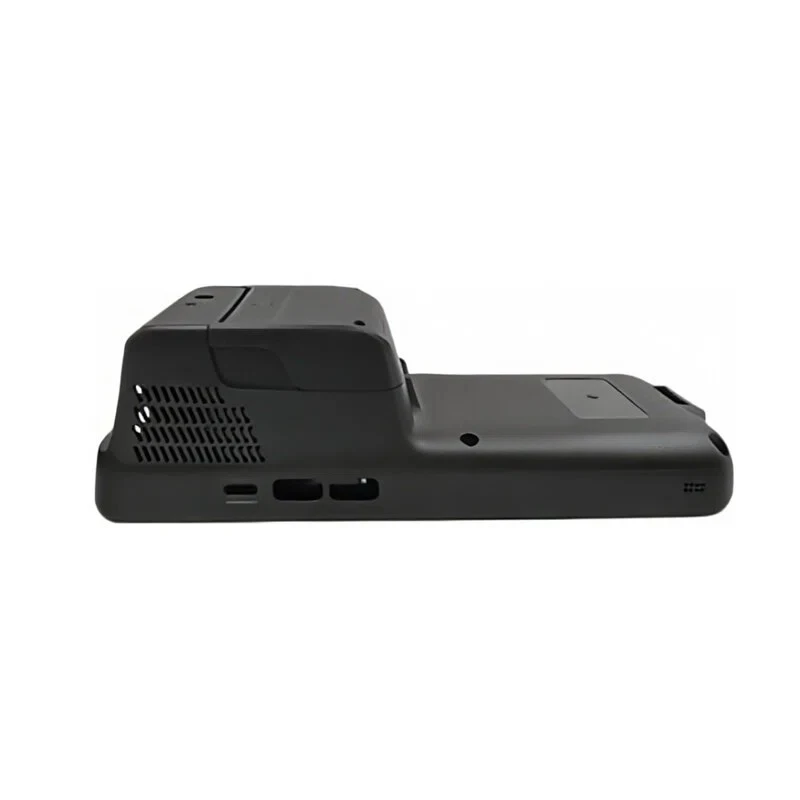
- Overall assembly footprint: 175 mm × 82 mm × 38 mm (main body); 165 mm × 68 mm × 95 mm (with grip extended)
- Total assembly weight (housing only, no electronics): 148 ± 3 g
- Drop resistance requirement: 1.5 m onto concrete, 6 faces — housing must not separate at snap-fit interfaces
- Operating temperature range for housing: -20°C to +60°C
- Interface sealing: IPX4 splash resistance at all port openings (USB-C, SIM tray, SD card door)
- Ventilation louver geometry: 22 × 1.2 mm parallel slots on grip rear with 0.8 mm rib width — structural bridge reinforcement required
- EMI shielding bosses: 14 × M2 brass threaded insert positions, hot-pressed post-molding
- Surface texture: MT-11020 equivalent on all grip surfaces; Mold Polishing Standard SPI B-2 on display bezel and front body
- Gate type: Submarine gate (grip components); pin gate (main body); fan gate (battery door)
- Mold steel: S136 (cavity inserts); P20 (core blocks)
- Mold life design target: 800,000 shots
Dimud's Solution
Step 1 — DFM Analysis and Design Optimization
Within five business days of receiving the 3D files, Dimud’s engineering team delivered a written DFM (Design for Manufacturability) report identifying 11 design issues across the six components. The most significant findings:
Snap-fit hook geometry: The original design used a uniform 0.8 mm hook deflection arm. Dimud’s mold engineers identified that at this wall section, PC+ABS at standard molding conditions would exhibit stress whitening under the 1.5 m drop loading. The team proposed increasing the deflection arm to 1.1 mm with a 15° lead-in taper, reducing insertion force while maintaining retention force above the 45 N specification. This change was modeled using Moldflow simulation before mold steel was cut.
Ventilation louver support ribs: The 0.8 mm ribs between the 22 ventilation slots created an L/D ratio of 28:1 after accounting for gate location, exceeding reliable fill limits for the specified ABS grade. Dimud proposed relocating the gate to a symmetrical dual-feed design and adding a 0.2 mm radius at each rib root, reducing stress concentration under flexural loading.
Draft angle on textured surfaces: Several grip body faces showed 0.5° draft angles with the MT-11020 texture specification. Dimud’s texturing partner requires a minimum of 1.5° per 0.025 mm texture depth for reliable ejection without drag marks. All affected faces were revised to 2.0°, with the client’s design team approving the dimensional impact within 48 hours.
Brass insert position reinforcement: Six of the 14 M2 insert bosses were positioned within 3.0 mm of outer walls. Dimud recommended adding perimeter gusset ribs at these locations to prevent boss pull-out under the thermal expansion cycles of field use.
Step 2 — Mold Engineering and Tooling
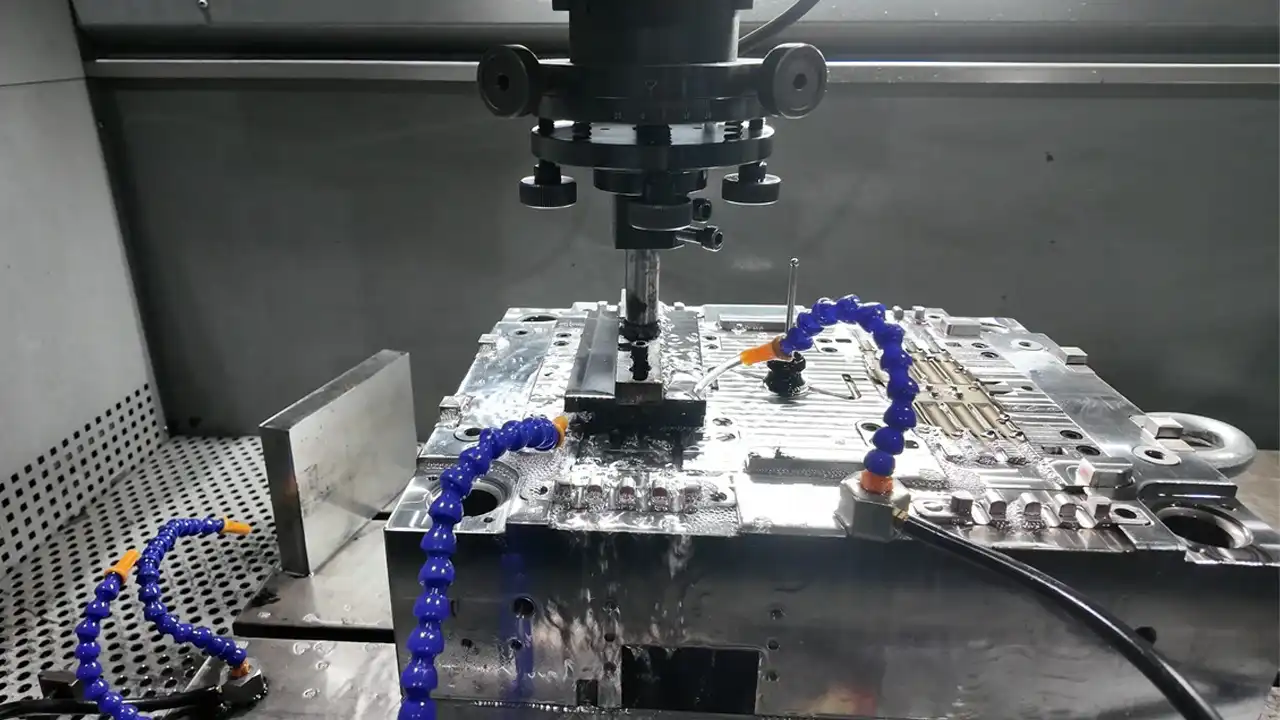
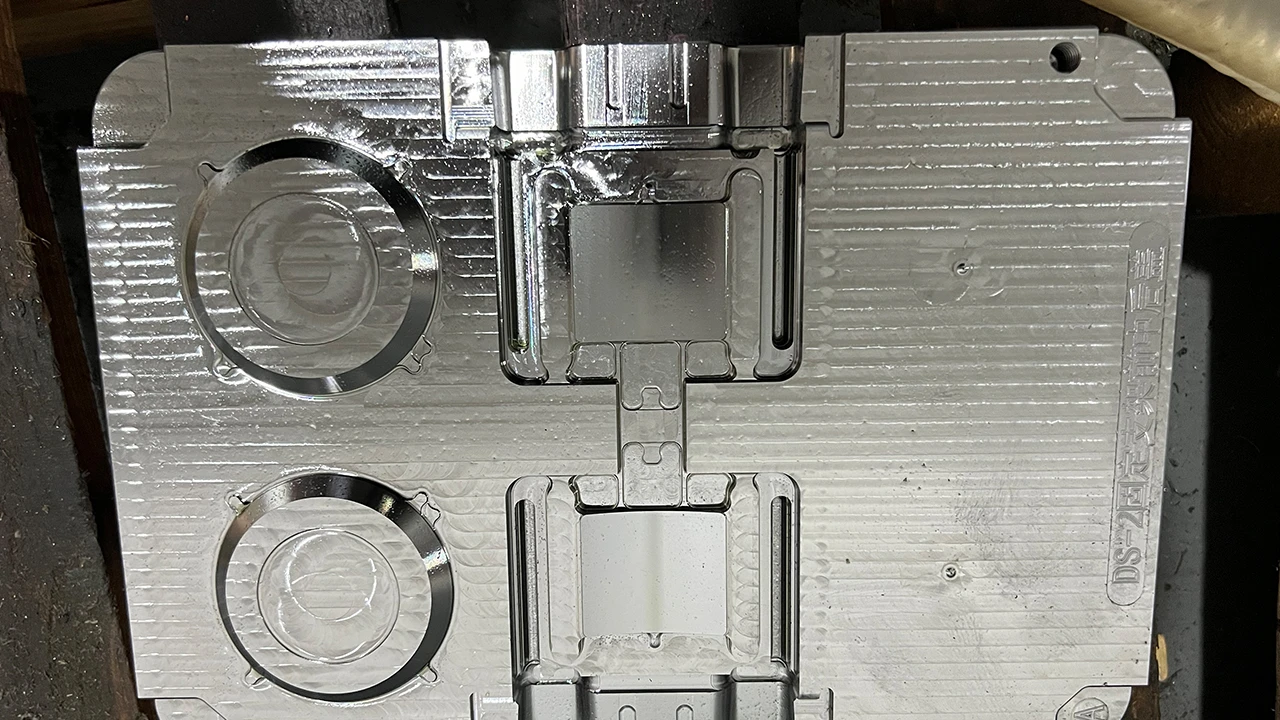
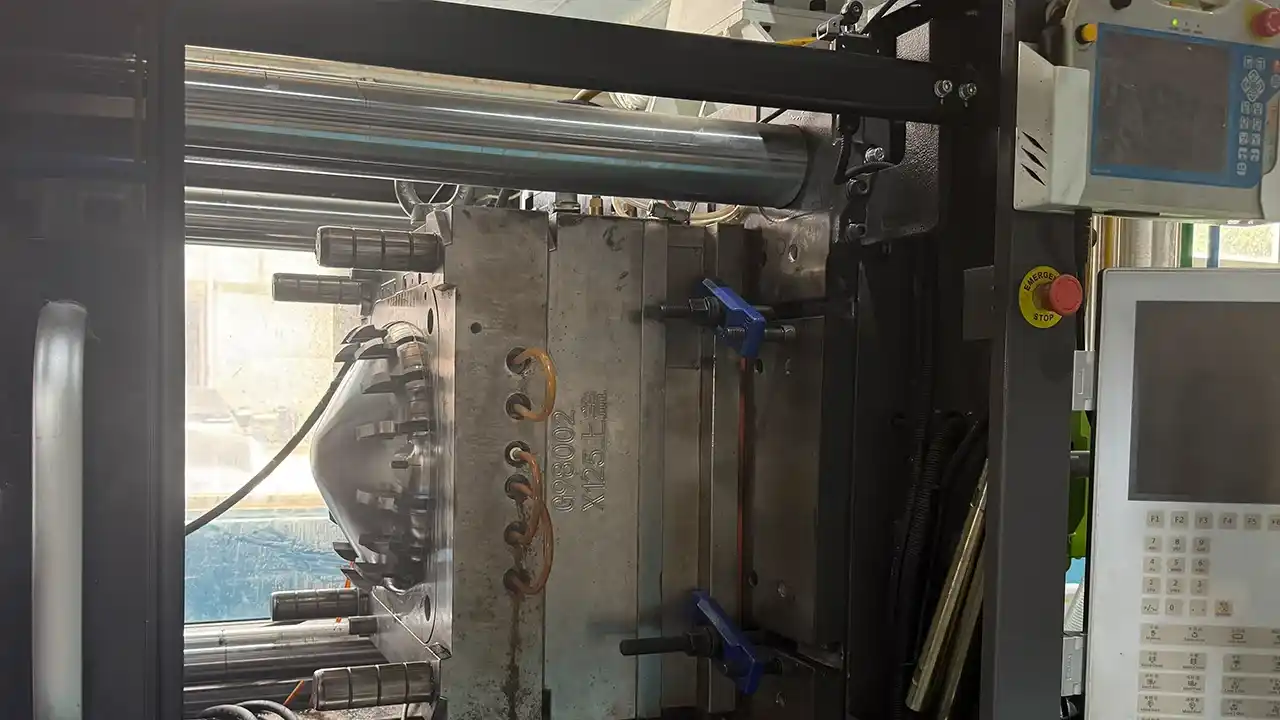
Mold construction was carried out at Dimud’s mold factory, using S136 tool steel for all cavity inserts in contact with the PC+ABS components — a material choice driven by PC+ABS’s higher abrasiveness compared to straight ABS. The grip body molds used P20 for the core and cavity blocks with S136 inserts at the snap-fit and ventilation louver features.
Key tooling decisions:
- Каналы конформного охлаждения were machined into the main body front shell cavity using wire EDM to achieve cooling uniformity within ±2°C across the part surface. This directly addressed the orange-peel texture inconsistency the client had experienced with their previous supplier.
- Side actions (lifters) were used at the USB-C port opening and the SIM tray recess to allow perpendicular undercut ejection without secondary hand-loading operations.
- Texture EDM was applied to all grip surfaces after polishing, with Dimud’s internal standard of 3 × EDM discharge passes to ensure depth consistency across the cavity surface.
- T1 trial was completed at day 28 from DFM sign-off. First-shot dimensional report was issued within 24 hours of T1 pull.
Step 3 — Process Qualification and First Article Inspection
The T1 samples were measured on a Zeiss CMM (coordinate measuring machine) against the client’s GD&T drawing package. Of the 47 critical dimensions specified, 44 were within tolerance on the first pull. The three out-of-tolerance dimensions were all on the main body rear shell PCB boss heights, which measured +0.07 mm high — attributed to insufficient packing pressure at the boss base. Process adjustment (packing pressure increased from 82 MPa to 89 MPa, with hold time extended by 1.2 seconds) brought all 47 dimensions into conformance on the T2 pull, completed at day 34.
Full material certifications, including RoHS compliance documentation and a material safety data sheet for both the PC+ABS and ABS grades, were provided with the T2 first article inspection (FAI) package. The client’s quality engineer approved the FAI within four business days, and production authorization was issued.
Step 4 — Mass Production and Quality Control
Production is run across two dedicated injection molding machines — a 350-ton press for the main body components and a 200-ton press for the grip and accessory components. Each production run includes:
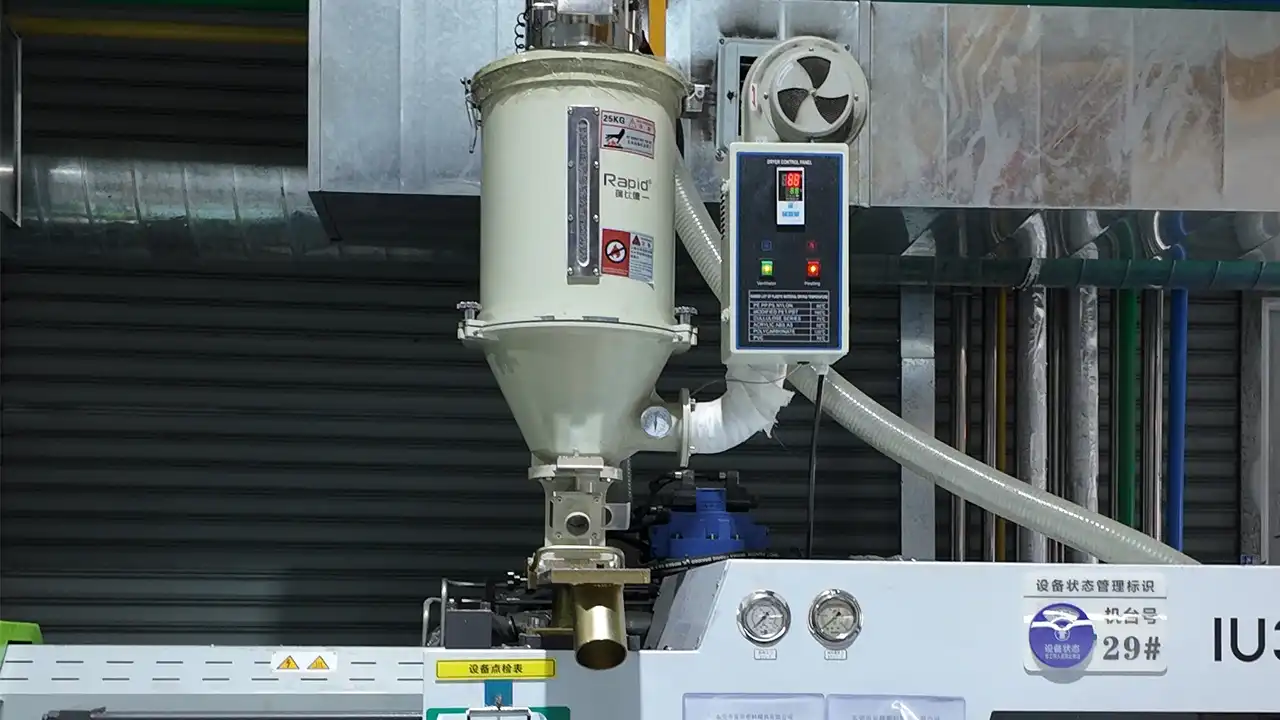
- Incoming material check: Moisture content measured on each resin lot using a Karl Fischer moisture analyzer. PC+ABS is dried at 90°C for 4 hours minimum; ABS at 80°C for 3 hours minimum before processing.
- First-off inspection: First 5 parts from each mold cavity are measured against 12 key dimensions on an optical CMM before full run authorization.
- In-process check: Dimensional sampling every 2 hours at 5 parts per cavity.
- Final inspection: 100% visual inspection for sink marks, weld lines, short shots, and surface contamination. Dimensional sampling at AQL 1.0 (Level II) for critical dimensions.
- Assembly fit check: 100% of main body + grip assemblies are function-tested by hand — snap-fit engagement force checked to confirm positive click within the 25–45 N specification band.
Brass inserts are pressed using a dedicated thermal press fixture, with all 14 positions torque-tested at 0.3 N·m (pull-out load specification: minimum 120 N axial).
Results and Outcomes
| Metric | Previous Supplier | Димуд |
|---|---|---|
| Snap-fit dimensional conformance | ±0.18 mm (out of spec) | ±0.04 mm (in spec) |
| First-pass visual acceptance rate | 91.8% | 99.4% |
| Однородность текстуры поверхности | 8–12% defect rate | <0.3% defect rate |
| DFM response time | 10–14 business days | 5 business days |
| T1 to production authorization | ~70 days | 34 days |
| Drop test pass rate (housing separation) | 93.8% | 100% (60-unit sample) |
| Annual cost per housing set | Baseline | −9.2% (tooling amortized over 36 months) |
The client’s engineering director sent written feedback stating that the dimensional stability of the snap-fit assembly was the most significant improvement over their previous supply arrangement, and that the DFM process had identified structural weaknesses they had not been aware of from their own internal review.
“Dimud’s engineering team understood the functional requirements behind every dimension — not just the numbers. The DFM feedback was specific, technically justified, and came back faster than anything we had experienced. That level of responsiveness from a manufacturing partner is rare.” — Engineering Director, German Industrial Technology Company (Logistics Automation Division)
Capabilities Demonstrated
This program demonstrates several of Dimud’s core manufacturing capabilities that differentiate it from single-factory injection molding suppliers:
Integrated three-factory model: The main body molds were designed and built at Dimud’s mold factory, run at the injection molding production facility, and the brass insert pressing and assembly verification were completed at the electronics and assembly facility — all within a single supply chain managed by one engineering team. Customers do not manage multiple vendor relationships or coordinate between separate tooling and production suppliers.
Precision mold engineering: Conformal cooling, S136 cavity steel selection, and symmetrical dual-feed gate design for the ventilation louver components are standard engineering practice at Dimud — not premium add-ons. These decisions directly determine dimensional stability and surface quality in production.
PC+ABS and ABS multi-material programs: Running two different resin systems (PC+ABS and ABS) within the same production program requires independent process qualification, separate material storage and drying protocols, and careful first-off inspection discipline. Dimud’s услуги литья пластмасс под давлением are built to manage this complexity at scale.
Electronics industry manufacturing standards: Dimud’s engineering team is certified to IPC-A-610 standards and maintains RoHS compliance documentation as a standard deliverable. For electronics enclosure customers, this removes a documentation burden that is often a source of delay in supplier qualification processes. Learn more about our electronics and semiconductor manufacturing capabilities.
ЧАСТО ЗАДАВАЕМЫЕ ВОПРОСЫ
PC+ABS alloy is the most widely specified material for rugged handheld terminal and industrial PDA enclosures. It combines polycarbonate's impact resistance and dimensional stability with ABS's superior surface finish and processability. At Dimud, PC+ABS (such as Sabic C6200 or equivalent grades) is our standard recommendation for device housings requiring drop resistance, tight dimensional tolerances, and consistent texture finishes. For grip components where ergonomic surface texture is the primary requirement and structural loading is lower, ABS alone is often a more cost-effective choice.
For a multi-component assembly like a handheld terminal housing, a realistic timeline from finalized 3D CAD to T1 sample is 25–35 business days at Dimud. This includes DFM review (5 business days), mold steel procurement (3–5 business days), CNC rough machining and EDM finishing (12–16 business days), and T1 trial and dimensional reporting (2–3 business days). First mass production shipment is typically achievable at 40–50 days from DFM sign-off, depending on part complexity and client FAI approval speed.
Yes. Dimud's integrated electronics and assembly facility performs brass and stainless steel insert pressing as part of the standard production workflow. Inserts are press-fit using calibrated thermal presses with fixture tooling designed for each part number. All insert positions are torque-tested against the specified pull-out force specification before shipment. This eliminates the need for customers to source and qualify a separate assembly supplier.
For PC+ABS components on well-designed molds with conformal cooling, Dimud routinely holds ±0.05 mm on critical snap-fit and interface dimensions. General dimensional tolerances across most feature types fall within ±0.08 – ±0.10 mm under controlled production conditions. Tighter tolerances (±0.02 – ±0.03 mm) are achievable on specific features with post-molding CNC finishing operations, which Dimud's CNC machining facility can provide as a secondary operation.
Surface texture consistency in injection molding is primarily determined by mold temperature uniformity and draft angle adequacy. Dimud uses conformal cooling channel design (where geometry allows) to maintain mold surface temperature within ±2°C across the cavity face. All textured surface drafts are verified against texture depth requirements during DFM review — a minimum of 1.5° per 0.025 mm depth for most texture classifications. Texture EDM is applied using standardized multi-pass discharge protocols, and cavity surface condition is inspected after every 100,000-shot production interval.
Dimud provides end-to-end manufacturing from mold engineering through mass production and assembly under an integrated three-factory model — mold, CNC, and electronics assembly — without the coordination overhead of managing multiple suppliers. Our engineering team delivers documented DFM analysis within five business days, and our production facilities operate under IPC-A-610 quality standards with CMM-verified dimensional reporting on every new program. For electronics enclosure programs specifically, we have active production programs across consumer electronics, industrial handheld devices, and medical equipment housings, giving our engineering team direct experience with the tolerance, finish, and regulatory documentation requirements that matter in these applications.
Заключение
Rugged handheld terminal housings represent one of the more technically demanding categories in consumer electronics injection molding — multi-component assemblies with functional snap-fit interfaces, mixed material systems, texture requirements, and field durability standards that leave no margin for dimensional variation. For the German industrial technology client, the transition to Dimud delivered measurable improvements across every critical metric: dimensional conformance, surface quality, production authorization speed, and per-unit cost.
Dimud’s approach — combining upfront DFM investment, precision mold engineering, and integrated production management — is designed for exactly this type of program: complex assemblies where manufacturing quality directly determines product reliability in the field.
If you are developing or scaling production of a consumer electronics enclosure, industrial device housing, or multi-component plastic assembly, Димуд is ready to review your design and provide a detailed DFM assessment and quotation.